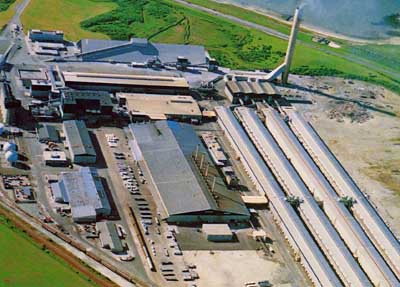
 THE RUNNING down of smelting facilities at Anglesey Aluminium is a devastating blow to the economy of Holyhead and the rest of the island of Anglesey, North Wales. The company (which at the beginning of the year employed over 500 and was estimated to account for a third of Anglesey's economy), will only retain around 80 workers.
Dylan Roberts and Iain Dalton
The immediate pretext for the closure of the plant is the ending of a discounted energy supply from Wylfa nuclear power station. The end of this deal had been on the cards for some time now - the closure of Wylfa, announced back in 2006, is expected in 2010. But the company has in the past stated that they would not be threatened by the closure of Wylfa. So what has changed now? The current crisis of capitalism and rising production costs are being used as a scapegoat, for attacks on pay and conditions and the switching of production to non-unionised plants in low wage economies, in order to drive up profit margins further.
In most cases, there is no pressing need to switch production; it is simply another case of profits coming before people. Such is the devastation that these job losses will cause to the island's economy that the Welsh Assembly and Westminster governments have been forced to intervene, offering £59 million in state subsidies over a four year period, which amounts to a massive £1 million a month.However, management at Anglesey Aluminium, Rio Tinto (which owns 51% of AA), and Kaiser Aluminium (49% ownership) rejected the deal, claiming that they would need at least double that figure in state subsidies to retain production on Anglesey. Yet Anglesey Aluminium has been extremely profitable in the 36 years it has been on the island.
Furthermore, both Rio Tinto and Kaiser Aluminium are multinationals turning huge profits. Rio Tinto posted record profits in 2008, delivering net profits in the first quarter of 2008 of an astronomical US $2.94 billion. They have not fared quite so well in the first quarter of 2009 but still made $1.6 billion in net profits in that period, or $177 million per day! Just like the banks, we see private enterprise demanding that the losses are nationalised while the profits remain private.
Despite redundancy notices being issued, the situation is not hopeless as the action at the Vestas Blades plant on the Isle of Wight shows. There, workers and their supporters have created huge pressure upon both the company and government to stop its closure. They are currently taking action to stop the remaining wind turbine blades and machinery being removed from the plant as part of their campaign to force the government to nationalise the plant.
In both cases the levels of profits of the multinational companies, and the continued profitability of these plants, demonstrates their viability. Both companies should be made to open their books to see where these profits have gone, and if necessary the plants should be nationalised, under democratic workers' control and management, to ensure future jobs and opportunities for skilled workers.


